
Digital Dental X-Rays
At Brant Smiles Family Dentistry, we use modern digital X-rays as a key tool for understanding your oral health. These images help us see what’s happening beneath the surface of your teeth and gums. They are essential for accurate diagnoses and creating effective treatment plans, all while prioritizing your safety and comfort.
What Are Digital X-Rays?
Digital X-rays are an advanced way for dentists to take pictures of your teeth, roots, and jawbone. Unlike traditional film X-rays, digital radiography uses a small sensor placed in your mouth to capture images. These images are then sent directly to a computer screen. This technology allows us to see details that are not visible during a standard visual examination. It helps us find issues like cavities between teeth, bone loss, or problems with tooth roots.

Types of Dental X-Rays
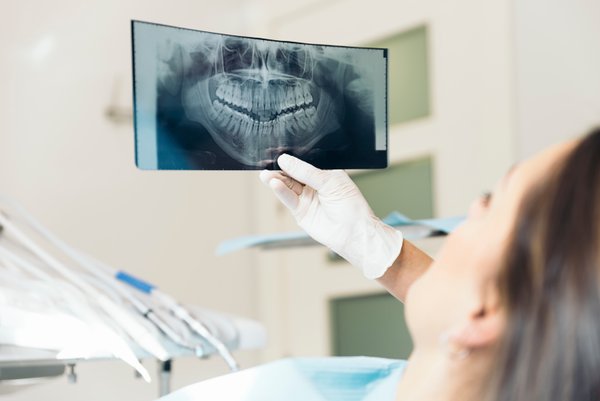
We use different types of digital X-rays to get a complete picture of your oral health. Bitewing X-rays are often taken during routine check-ups to look for cavities between your back teeth and to check the health of your bone. Periapical X-rays focus on one or two teeth, showing the entire tooth from the crown to the root tip, including the surrounding bone. These are useful for diagnosing issues like abscesses or problems with root canals. For a broader view, panoramic X-rays capture an image of your entire mouth in a single shot, including all teeth, both jaws, and surrounding structures. This helps us assess wisdom teeth, jaw joint issues, or plan for orthodontic treatment.

Advantages of Digital Technology
Digital X-rays offer several important benefits for our patients. One of the most significant advantages is the reduced radiation exposure compared to older film X-rays. This makes the procedure safer for you. The images are also available almost instantly on a computer screen, which means less waiting time during your appointment. This speed allows us to discuss our findings with you right away. Furthermore, digital images provide high resolution, allowing us to zoom in and adjust brightness or contrast for a more accurate diagnosis. This clarity helps us explain your oral health needs more effectively.

What to Expect During Your X-Ray
Getting digital X-rays is a quick and straightforward part of your dental visit. First, you will wear a lead apron to protect your body from any scattered radiation, even though digital X-rays use very low doses. A small sensor, which is connected to a computer, will be carefully placed in your mouth. We will ask you to bite down gently to hold it in place. The X-ray machine will then be positioned to capture the image. This process is repeated a few times to get all the necessary views of your teeth and jaw. The entire procedure is very fast, and the images appear on our computer screen within moments.
Our Commitment to Your Safety
Your safety and well-being are always our top priority at Brant Smiles Family Dentistry. We understand you might have questions about dental X-rays, and we want to assure you that modern digital X-ray technology is very safe. Digital X-rays use significantly less radiation than traditional film X-rays, minimizing your exposure. To further enhance your safety, we always use lead aprons during the imaging process. Our team is trained to follow strict safety protocols to ensure that every X-ray taken is both necessary and performed with the utmost care. We are here to answer any questions you have about our safety measures.

Frequently Asked Questions
Are digital X-rays safe?
Yes, digital X-rays are considered very safe. They use significantly less radiation compared to traditional film X-rays. We also use lead aprons to protect you during the process, ensuring your exposure is as minimal as possible.
How often do I need dental X-rays?
The frequency of dental X-rays depends on your individual oral health needs and risk factors. For some, it might be once a year, while others may need them less often. Your dentist will recommend a schedule that is best for you based on a thorough examination.
What can digital X-rays detect?
Digital X-rays can detect many issues that aren't visible during a regular dental exam. This includes cavities between teeth, bone loss, infections, cysts, tumors, and problems with tooth roots or developing teeth. They are crucial for early diagnosis and effective treatment planning.
Do digital X-rays hurt?
No, getting digital X-rays is a painless procedure. A small sensor is placed in your mouth for a few seconds to capture the image. While you might feel a slight pressure from the sensor, it is designed to be as comfortable as possible. The process is very quick.